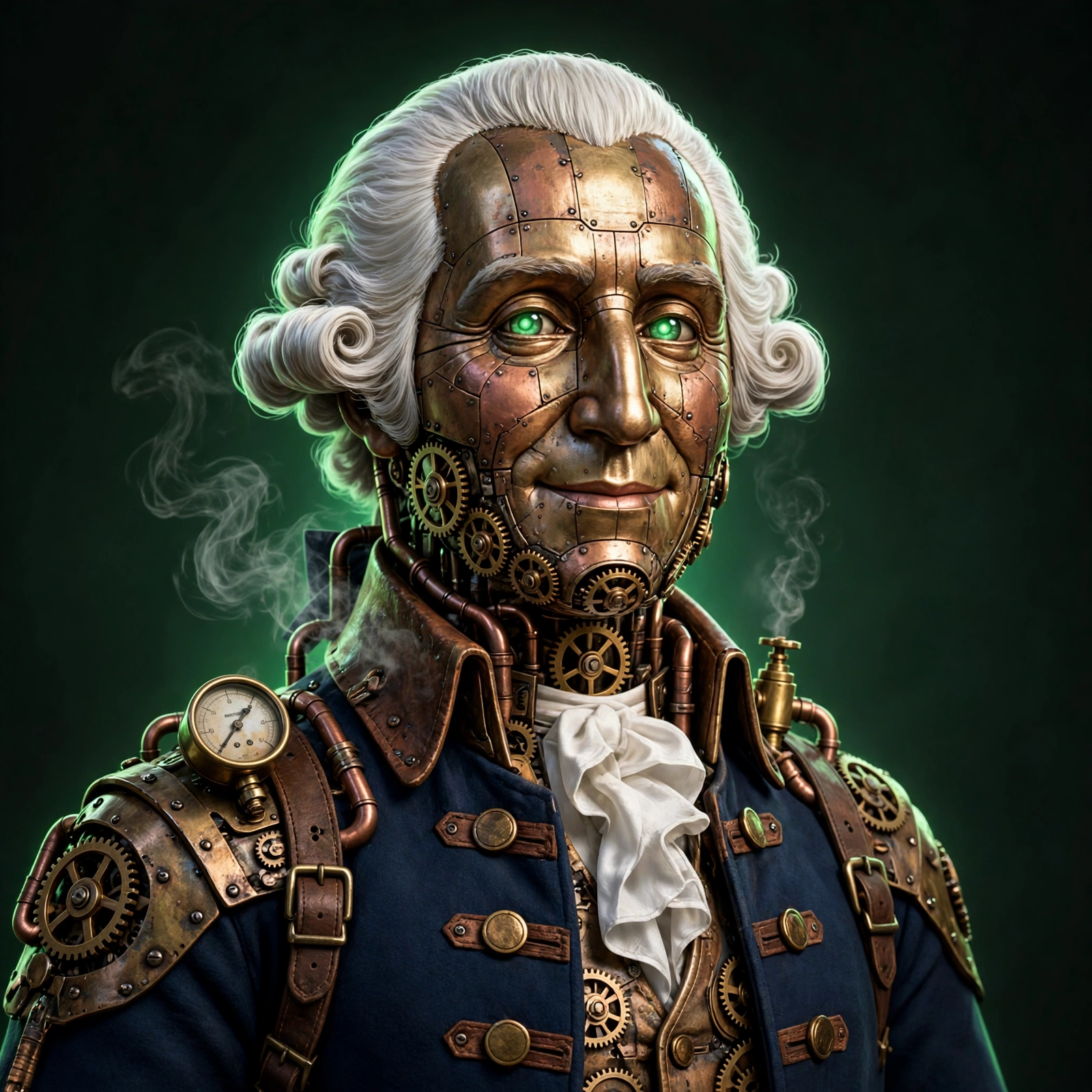
George Washington
1st President of the United States · No party — the only president with none · 1789–1797
The steampunk George on this site is our mascot, drawn for BotMash. The man rated below is the real one.
Record at a glance
The precedents he set, the warnings that were ignored, and the contradiction he never escaped — rated by the same rubric as a sitting governor. The mascot gets no gentler ink.
The Presidency
He said he would step aside — and did
KeptIn his own words…it appears to me proper, especially as it may conduce to a more distinct expression of the public voice, that I should now apprise you of the resolution I have formed, to decline being considered among the number of those, out of whom a choice is to be made.
What happened
He meant it. His second term ended on March 4, 1797, he retired to Mount Vernon, and he never held public office again. The two-term tradition he started held for more than 140 years, until Franklin D. Roosevelt won a third term in 1940 and a fourth in 1944. In 1951 the 22nd Amendment wrote Washington's example into the Constitution itself.
Farewell Address published — a printed letter, never a delivered speech
Second term ends; he goes home to Mount Vernon
FDR breaks the tradition — the only president who ever did
22nd Amendment ratified: two terms, now law
He warned the country against political parties
BrokenIn his own wordsLet me now take a more comprehensive view, & warn you in the most solemn manner against the baneful effects of the Spirit of Party, generally.
What happened
The warning was ignored almost immediately — parties had already formed around him, during his own presidency: Federalists behind Hamilton's program, Democratic-Republicans behind Jefferson and Madison. The fight over Washington's own neutrality policy helped create them. The 1796 election, the first after him, was a fully partisan contest. One fairness note: the failure on this card is the country's, not the man's conduct — he governed without a party to the end, the only president who ever did. But the warning was the promise, and the warning did not hold.
Federalists and Democratic-Republicans form during his presidency
The warning runs in the Farewell Address
First post-Washington election is openly partisan
Foreign Relations
Steer clear of permanent alliances
KeptIn his own words'Tis our true policy to steer clear of permanent Alliances, with any portion of the foreign world—So far, I mean, as we are now at liberty to do it—for let me not be understood as capable of patronising infidility to existing engagements.
What happened
He had already practiced it. When France declared war on Britain in 1793, Washington's Neutrality Proclamation committed the United States to “a conduct friendly and impartial toward the belligerent Powers” — despite America's 1778 treaty with France. Congress backed him with the Neutrality Act of 1794, and the country stayed out of the French Revolutionary wars for his entire presidency. A caution this card enforces: “entangling alliances” is Jefferson's phrase, from 1801. It is not Washington's, and it does not appear here.
Neutrality Proclamation issued
Neutrality Act gives the policy legal force
Farewell Address restates it as permanent policy
He leaves office with the United States at peace
Rights
Religious liberty is a right, not a favor
KeptIn his own wordsIt is now no more that toleration is spoken of, as if it was by the indulgence of one class of people, that another enjoyed the exercise of their inherent natural rights. For happily the Government of the United States, which gives to bigotry no sanction, to persecution no assistance requires only that they who live under its protection should demean themselves as good citizens, in giving it on all occasions their effectual support.
What happened
Washington was writing to the Hebrew Congregation in Newport, Rhode Island — and the famous phrasing was theirs first: their warden, Moses Seixas, had used “gives to bigotry no sanction, to persecution no assistance” in the congregation's address to him, and Washington adopted it back as the government's own words. Sixteen months later, on December 15, 1791, the Bill of Rights was ratified — opening with the First Amendment's bar on any law “respecting an establishment of religion, or prohibiting the free exercise thereof.”
Newport's Hebrew Congregation addresses Washington
His reply: bigotry no sanction, persecution no assistance
Bill of Rights ratified, religion clauses first
Slavery
He wished for abolition — and freed only his own, at death
CompromiseIn his own wordsI can only say that there is not a man living who wishes more sincerely than I do, to see a plan adopted for the abolition of it—but there is only one proper and effectual mode by which it can be accomplished, & that is by Legislative authority: and this, as far as my suffrage will go, shall never be wanting.
What happened
The context stays on the card: that 1786 letter was written to object to Quaker abolitionists' legal tactics, and no legislative abolition plan was ever adopted in Virginia or Congress in his lifetime — he never publicly campaigned for one. What he did do came in his will: “all the Slaves which I hold in my own right, shall receive their freedom” upon his wife's death. At his death, 317 people were enslaved at Mount Vernon — 123 his, 153 “dower” slaves from the Custis estate he had no legal power to free, and 41 rented. Martha freed his 123 on January 1, 1801. The dower slaves stayed enslaved, divided among the Custis grandchildren. He remains the only slave-owning president who freed the people he owned — freed, but only after a lifetime of their labor, and only his share of them.
Letter to Robert Morris: the wish, in his own words
His will orders his own slaves freed after Martha's death
Washington dies; 317 people are enslaved at Mount Vernon
His 123 are freed; the 153 dower slaves are not
Education
A national university, funded in his will
StalledIn his own words…it has been my ardent wish to see a plan devised on a liberal scale… my mind has not been able to contemplate any plan more likely to effect the measure than the establishment of a UNIVERSITY in a central part of the United States… Item I give and bequeath in perpetuity the fifty shares which I hold in the Potomac Company… towards the endowment of a UNIVERSITY to be established within the limits of the District of Columbia.
What happened
Washington proposed a national university to Congress in 1790 and again in his final annual message in 1796. Congress never created it. He never dropped it — he was still funding the idea in his will, leaving fifty Potomac Company shares toward the endowment. The shares never funded a university: in Mount Vernon's words, it “never materialized.” No national university exists today. Washington did his part of this one to his last day; the institution he asked for simply never picked it up — and after two centuries, this is the one card on the page whose window has closed for good.
Proposed to Congress in his first annual message
Proposed again in his final annual message
His will leaves 50 Potomac Company shares to endow it
No national university was ever established
Every quote on this page is George Washington’s own words, checked against the full text at Founders Online, Mount Vernon, or the National Archives, and every card links its source. The research archive for this page is kept with the site and available on request.
How every rating works
Same rubric, same timelines, every party — and every century. Only the figure’s own words count as the promise. No status without a source link.
Clear action matches the promise — a law passed, a program funded, a vote in the promised direction.
Documented steps are moving: a bill introduced, sponsored, or publicly advancing.
A fair window passed — a full session or a Congress year — with no meaningful action.
Acted opposite to the promise, or abandoned it in public.
Partial delivery that changes the scope, timing, or dollars of the original promise.
Too vague to test, or no source yet. We would rather say that than guess.
The trust rules
Disputes are public and hold a rating as Under Review until a person resolves them in writing — bots never close disputes. No rating ever changes silently: every change lands in a public change log with a date and a reason. Corrections are published on the same page they fix. Bots collect and match; published rules rate; humans review.